Digital Maturity & AI Adoption Across Europe: Insights From 2025
December 2nd, 2025
A survey conducted by the European group team.blue across its 23 brands (including Webnode) has highlighted the significant steps businesses have taken in 2025 to leverage digital tools and artificial intelligence. Additionally, the survey identifies room for improvement, the challenges faced by evolving, and where further guidance is required to achieve digital maturity.
A business is considered mature once it has achieved successful integration of modern digital tools into its structure that aid in regular operations and offer a competitive edge in meeting strategic goals.
Let’s take a closer look at European digital transformation trends. Understanding these findings helps businesses see where they stand and which tools could help them grow in 2026 and beyond.
Digital Maturity Snapshot: A new team.blue survey of 8,200 European companies reveals that while SMEs (small and medium-sized enterprises) and self-employed professionals are eager to embrace digital tools and AI, many aren’t sure how to get started. Uncertainty, limited time, and a lack of expertise often slow their progress. Team.blue and Webnode offer intuitive tools, dedicated local assistance, and deep expertise that make digital growth both attainable and secure.
Who participated
Over 8,200 responses were received from 32 countries across Europe in 16 different languages. These primarily consisted of small or independent businesses, with 53% being solopreneurs and another 31% being teams of 2 to 9. Medium-sized companies were included, while just 2.1% of respondents had 500+ employees.
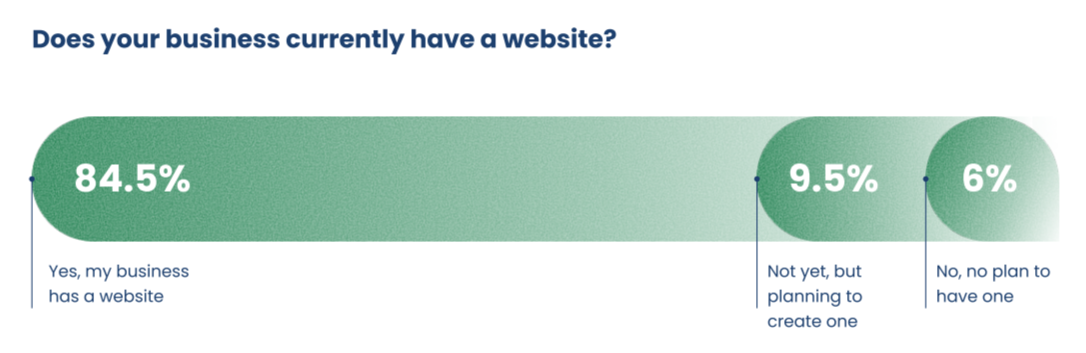
Nearly 85% of these respondents have a website in their digital toolset:
What businesses reported
Most team.blue respondents are confident with the basic digital environment used by modern businesses. Social media is the most widely used tool, with about 74% using it to increase reach, connect with customers, and promote work. Cloud storage follows on the heels of social media at 73%, signifying the importance of storage and information sharing in everyday operations.
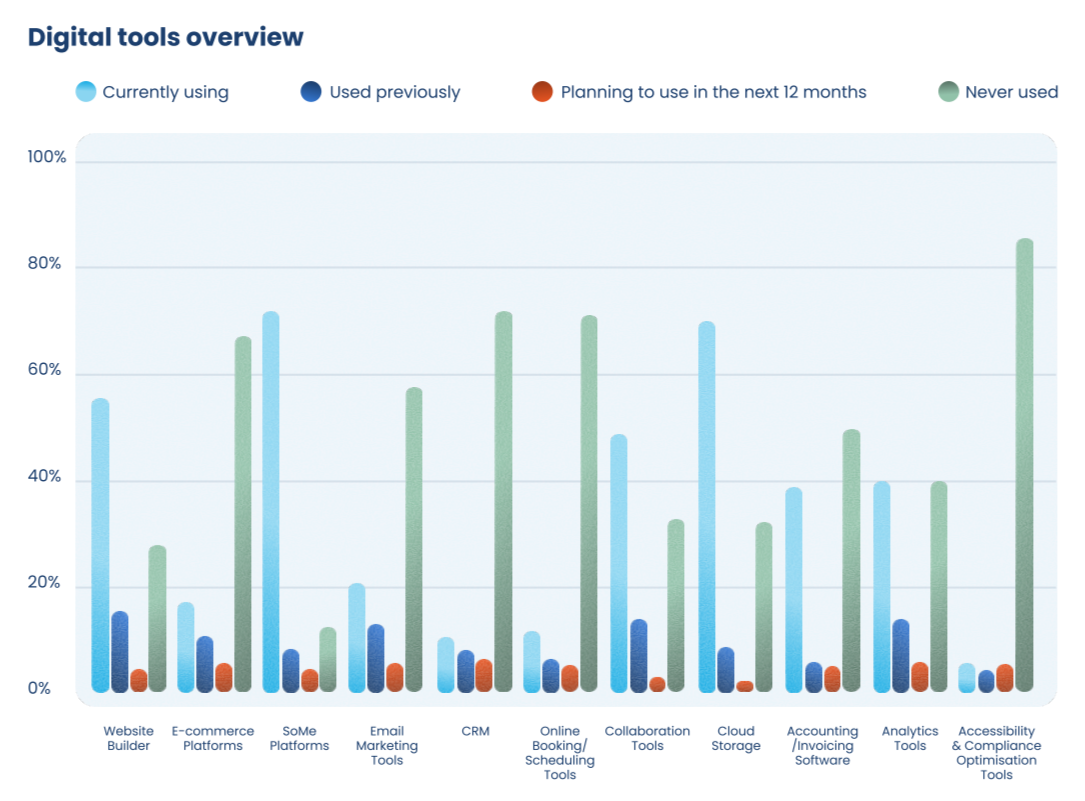
In comparison, more specialized digital tools involving accessibility, compliance, and optimization have never been used by 85% of respondents. CRM and online booking tools were unused by around 75%.
The findings suggest that businesses either don’t recognize the value of these features in the digital environment or that they don’t have the know-how or time to integrate them to satisfaction.
Here are the key takeaways:
- Larger companies are more likely to use collaboration and customer management tools.
- New businesses show their curiosity and report ‘planning to use’ on a wider range of digital tools more than any other group.
- Analytic tools, website builders, and email marketing platforms rank highest for ‘used previously’, suggesting businesses may graduate from these to other tools or abandon them if there is a significant time or complexity constraint.
What respondents said about websites
Respondents describe websites as necessary but sometimes complicated to update and manage—highlighting the importance of customer-friendly website builders. Most report that their website serves more as a source of credibility instead of a driver of revenue, particularly outside digital-first sectors.

The businesses that do describe their website as a significant driver of revenue (typically between 26% and 75%) tend to be in sectors where customers do research, compare products/prices, or buy online—tech, IT services, and retail/ecommerce. In these cases, the website serves as a core part of their operation.
More generally, businesses use websites as a marketing asset rather than a sales engine. It helps extend reach and signal credibility, or as the report says, “The value of a website is less about what that website can do and more about what it confirms,” meaning that the business is legitimate, visible, and trustworthy.
This is reflected in the data collected:
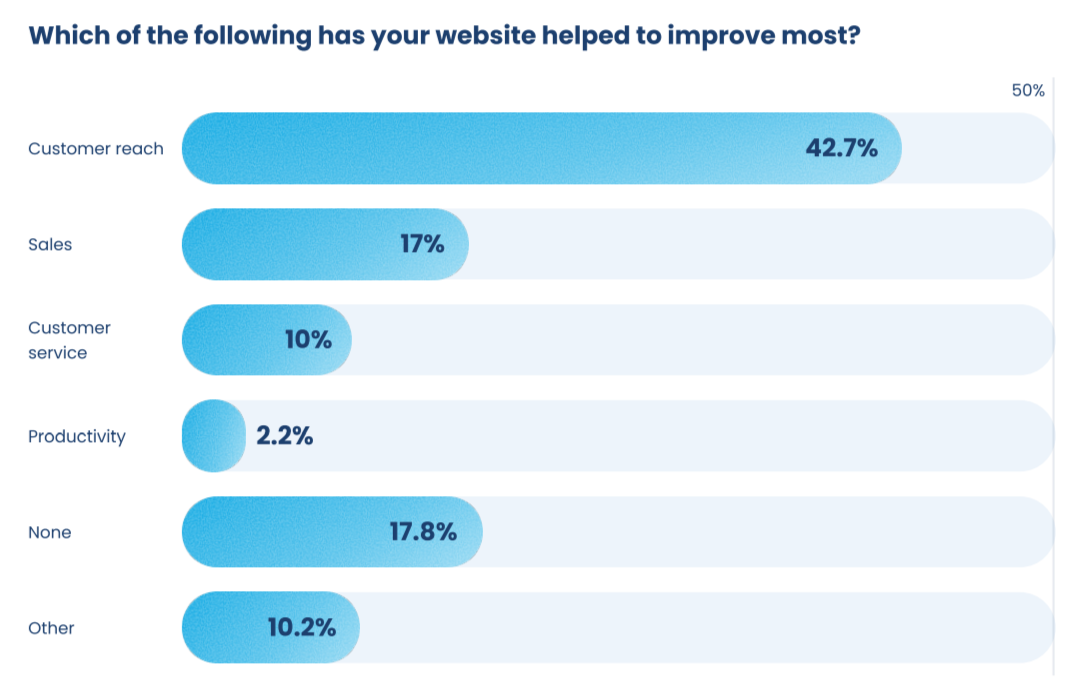
The main objection to creating a website is that they can sometimes feel time-consuming or complicated to maintain.
Interested in experimenting with an easy-to-use website builder? With Webnode, you could have an AI-powered site live in under a minute.
The challenges businesses face
While most businesses have a fundamental digital setup (social media, collaboration tools, and a website) and consider themselves open to new technology, they are sometimes held back by confusion, a lack of time, or limited skills.
When asked about their obstacles to adopting AI and other innovative technologies, 20% reported that they are fully embracing them, whereas:
- 19% said they simply don’t know what tools they should be using
- 17% said they don’t have the skills or knowledge
- 13% said they have no time or resources
A small group of respondents reported not seeing the value of these tools. 59% of this group have been in business for more than 10 years, implying an ‘if it ain’t broke, don’t fix it’ mindset.
Despite most respondents believing digital maturity will give their business a competitive edge in the next two years, the main obstacle for AI adoption is trust, reliability, and familiarity and confidence in human workers.

Solutions for digital maturity
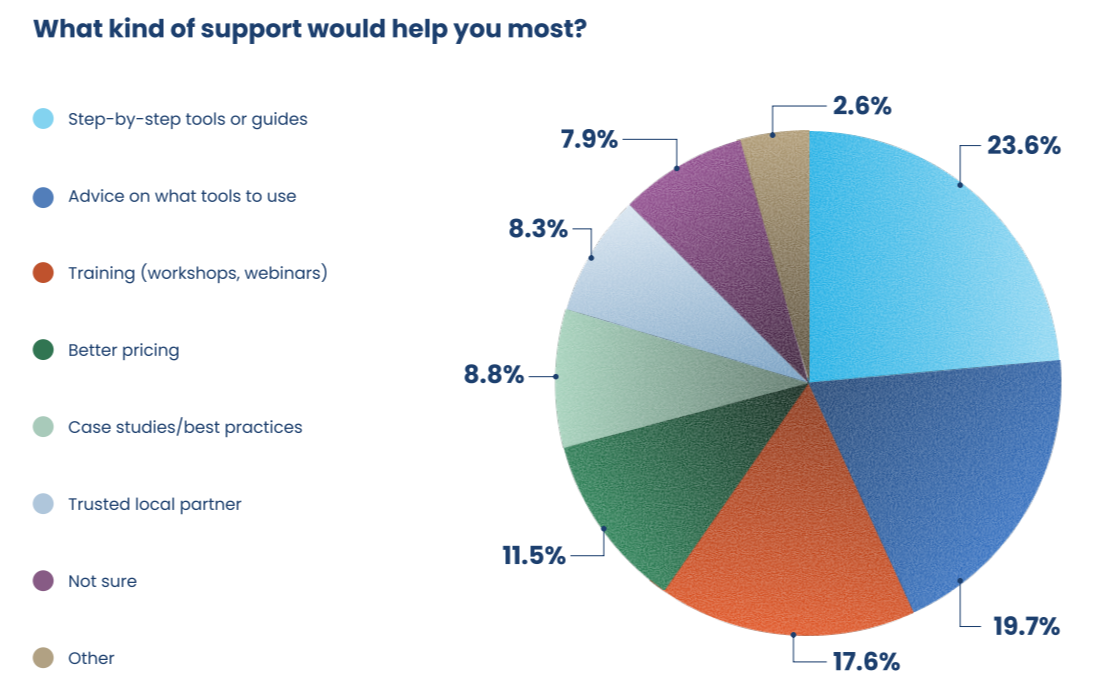
Whether a business has been in operation for more than a decade or is new and curious, its workers report wanting hands-on, step-by-step human guidance on the use of artificial intelligence in a business. This further indicates that, although respondents see AI as transformative, they deal with decision fatigue and a lack of clarity regarding the next step.
Businesses that invest in training and professional guidance are therefore more likely to adopt the right AI tools if they support their daily operation, use those tools effectively, and reach overall digital maturity.
Thoughts on the European digital future
The digital readiness of European businesses is on the rise, as showcased by team.blue’s digital maturity survey. AI adoption in Europe is on the increase, and many see it as a transformative force that will give them a competitive edge in the next two years.
But what are the barriers to AI adoption in Europe and how ready are European businesses for AI? While some older companies are more conservative about AI use, younger companies are more open to new technologies.
Businesses on the fence, regardless of years in operation, are more likely to reach digital maturity and seek AI integration with step-by-step, human guidance on how to pick the right tools, prevent decision fatigue, and if they receive proper training.
Nevertheless, European digital transformation trends show that modern technologies, including social media, AI, and website builders are becoming widely embraced.
If you’re looking to improve your digital readiness, you can make a no-nonsense website with Webnode for free.

Jamie Faulkner writes and edits copy to build community, inform, and inspire action through blogs, newsletters, and email strategy. He is particularly interested in sustainability, technology, travel, health and fitness, and education. Above all, he is passionate about storytelling—both in the marketing world, helping brands connect with their audiences, and through his published short fiction. Jamie is also the co-founder of education provider Discourse Hub, where he teaches and creates content for blogs, newsletters, and social media.